
Rebrands are usually announced with a new logo and a paragraph about “our journey.” We’d rather explain the actual problems we were solving, because they say more about Morpho than any tagline could.
The logo that couldn’t share a sign
Morpho works alongside hotel owners, and often alongside the brands their properties carry. That means our name regularly appears on the same façade, fascia or pylon as someone else’s.
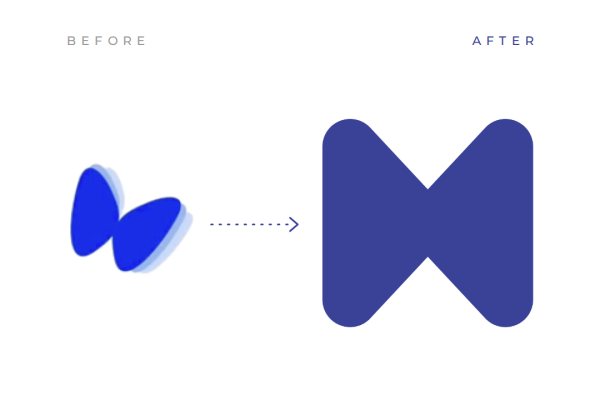
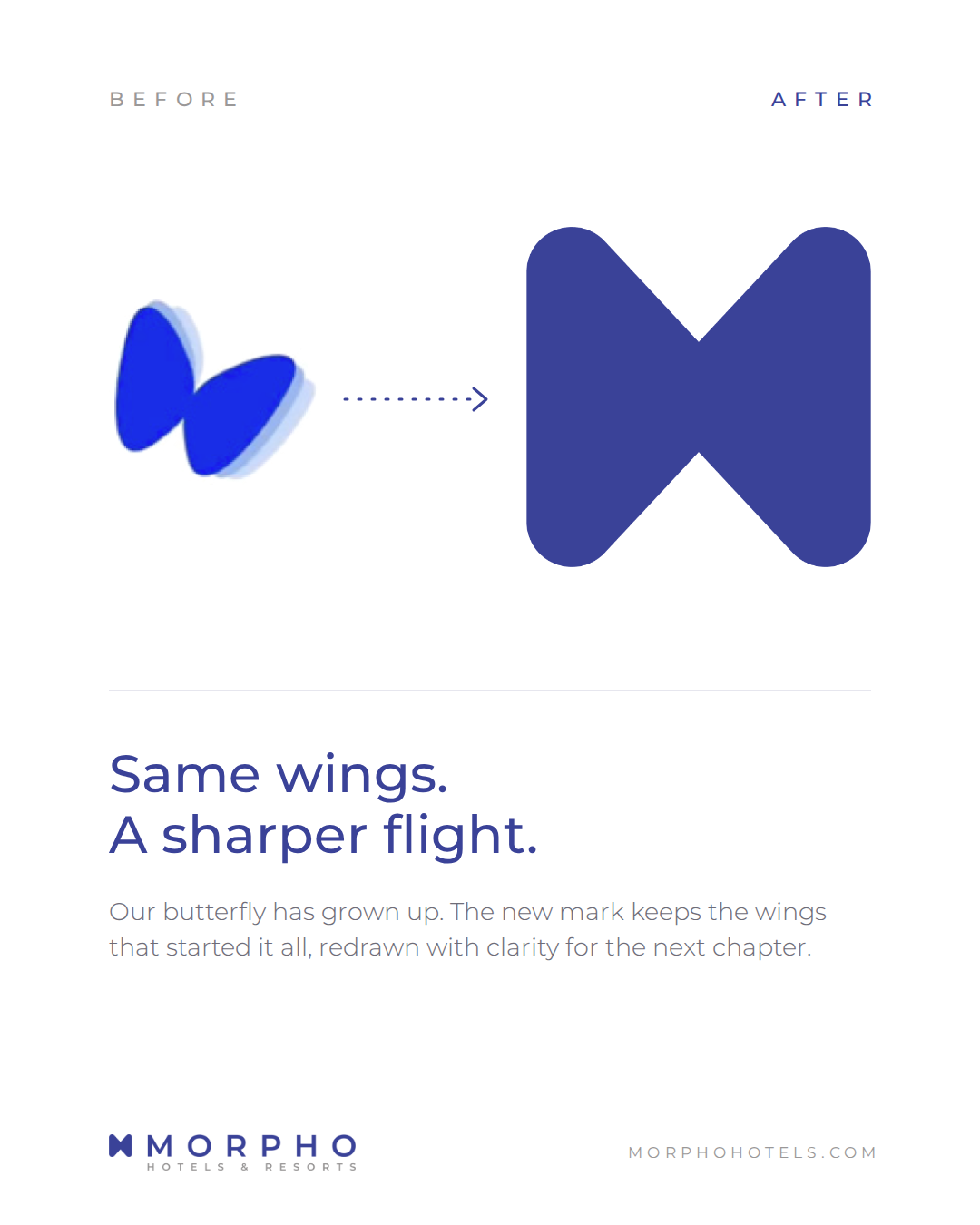
Our previous logo wasn’t built for that. It had a large horizontal butterfly symbol, layered offset shading and a light grey wordmark. That made it hard to fit into standard co-branded signage, difficult to fabricate cleanly in materials like acrylic, metal or backlit panels, and weak in contrast at a distance. Brand managers had to work around it on every new property.
A management company’s identity should make partnership easier, not harder. That was the first brief.
One mark, three readings
The new Morpho mark is a single, solid M. It’s built to reproduce in one colour, at any size, on any surface. It’s also built to hold more meaning than the old symbol did.
- The butterfly. Morpho is named after one of nature’s most striking butterflies. The M’s two halves read as folded wings, so the symbol of transformation is still there, now in a simpler form.
- The bow tie. Turn your attention to the centre and the M becomes a bow tie, hospitality’s oldest shorthand for service. The French call it a nœud papillon, a butterfly knot. The connection isn’t one we invented. It was already in the language.
- The letter. Above all, it’s an M: ownable, legible and easy to remember.
The real reason: owners deserve one system, not a stack of vendors
The identity work pushed us to ask a harder question about what, exactly, Morpho promises.
Across the industry, hotel owners typically assemble performance from separate providers. One agency handles digital marketing, another handles revenue management, a third runs operations, and someone else manages distribution. Each may be competent. But the handoffs between them are where value leaks: rates that don’t match demand, campaigns that fill the wrong rooms, operations cost-cutting that undermines guest experience. When results fall short, every provider can point to someone else.
Owners don’t need more services. They need one system that is accountable for the outcome.
Demand to Profit
Demand to Profit is Morpho’s integrated operating framework. It covers every critical service required to turn a property into a profitable asset, designed to work as one connected system:
Operational Excellence
Morpho establishes governance structures that align operations with financial performance. (Know more)
Hotel Revenue Intelligence
Morpho’s Revenue Intelligence pillar replaces reactive pricing with a structured, data-driven yield management discipline. (Know more)
Demand generation & Discoverability
Morpho’s demand system ensures that the right demand reaches the hotel, through the right channels, at the right acquisition cost. (Know more)
Hotel Unified Business Intelligence
The reporting, analytics, and governance framework of the D2P operating system (Know more)
Because it’s one system, it plugs into a property and starts working without months of stitching separate vendors together. And because it’s one team, accountability sits in one place, from the first enquiry to the final line of the P&L.
Structure, not surface
The Morpho butterfly’s famous blue contains no blue pigment. Its colour comes from the microscopic structure of its wings, which bends light into that brilliant shade.
We think hotel performance works the same way. Fresh paint and a new website can change how a property looks. Lasting results come from the structure underneath: how demand is created, priced, converted, delivered and turned into profit.
That’s what the new Morpho stands for. A simpler mark on the outside, and a more complete system underneath, built to help every property we work with evolve into the asset it should be.
Own or Operate a Hotel?
Talk to us about Demand to Profit. Connect with Morpho to unlock consistent margins and stronger EBITDA outcomes.